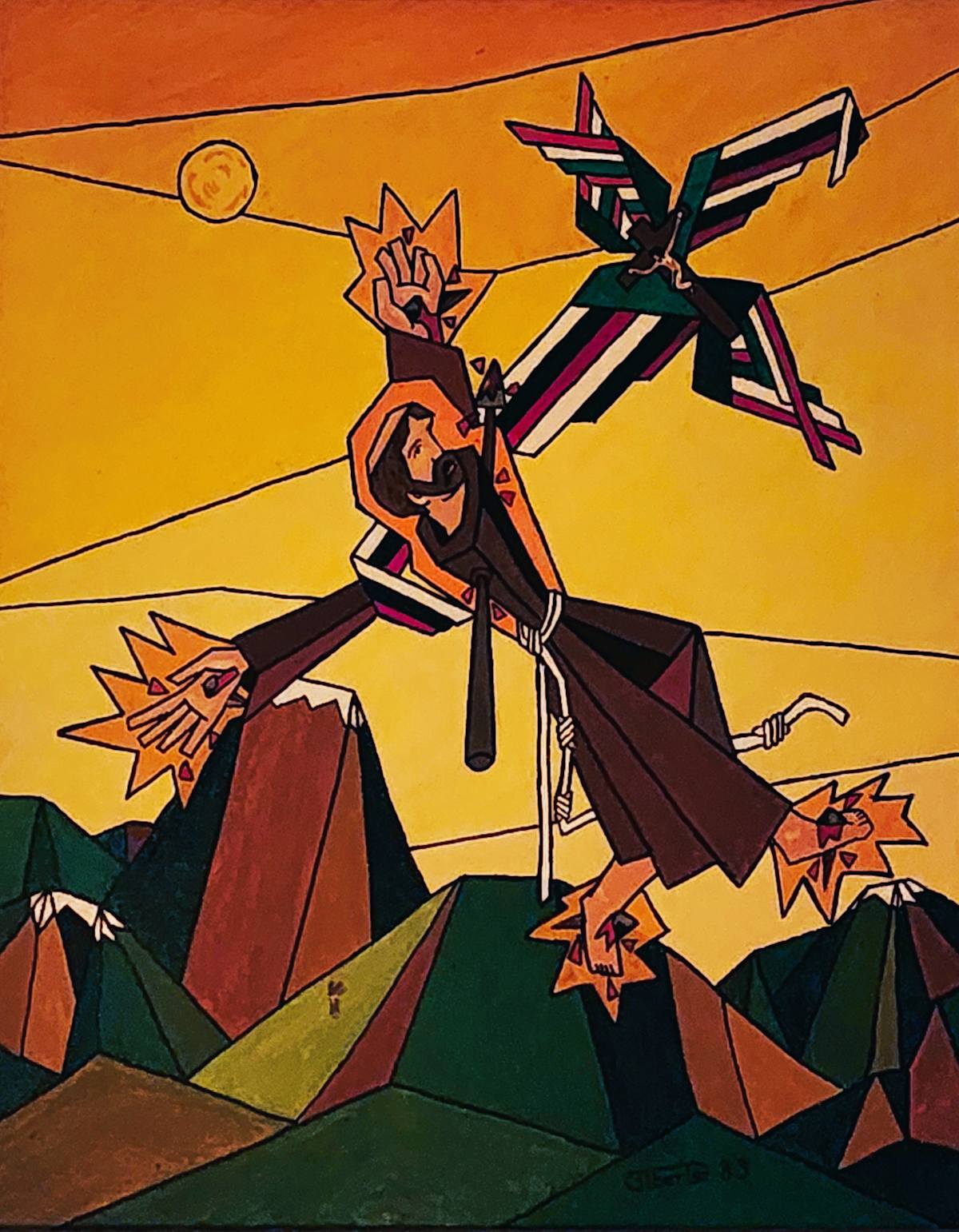
Four days after the Franciscan Family marked the 8th Centenary of Francis's Stigmata in 2024, I found myself still turning the image over in prayer. Like the nails that pierced our Savior's body, the wounds of our brother and founder have penetrated the spirituality of all three Orders that claim him. Carrying that legacy forward means keeping the love of the Crucified Lord at the center of who we are.
My reflection on the Stigmata owes a great debt to my teacher Chiara Frugoni and her monumental, still-untranslated study, Francesco e l'invenzione delle stimmate. Frugoni reads Francis through the Franciscan sources and the images that followed him, above all Bonaventure's and Giotto's. I want to build on her work from where I stand, as a Latino spiritualogian, and I believe that vantage point must begin with Francis himself.
Francis never once mentions the Cross of San Damiano, which invited him to rebuild the Church. He never once mentions the Seraph that left him marked. What he talks about is the leper. Not leprosy as an affliction, but the leper as a person. That encounter is where his journey of reparation begins, and it is where he slowly grows marked by his crucified and risen Lord, Spouse, Brother and Son, Jesus.
Brother Leo's witness
The earliest accounts of the Stigmata come from Brother Elias's encyclical letter announcing Francis's death and from Thomas of Celano's First Life. But I do not consider theirs the oldest testimony. That honor belongs to Brother Leo, Francis's intimate companion, who was with him on Mount La Verna and is the only friar to whom Francis ever explained what happened there.
Leo's own parchment, the Assisi Chartula, survives in the Basilica of San Francesco, one of only two documents in Francis's own hand. In red ink, Leo tells us that Francis wrote the Blessing and the Praises of God Most High post visionem et allocutionem seraphym et impressionem stigmatum Christi in corpore suo, (after the vision and conversation with the Seraph and the impression of Christ's stigmata on his body). That is the whole of what Leo says about the event. He does not narrate the vision. He simply tells us that afterward, Francis was changed.
Context matters here. Francis chose that Lent, the Lent of Mary and Michael, to get away from his own brothers. He had returned from Egypt exhausted, watching the Order he had founded reshaped by friars pulling it toward the monastic patterns he had tried to leave behind. He had resigned as General Minister. He was ill, tempted, depressed and, by his own admission to Leo, unable to satisfy or comfort the brothers he loved. It was in that depletion that the hand of the Lord came upon him, the wounded hand of his Brother Jesus wounding the hands of Francis, who in turn blessed Leo, and through Leo, all of us.
That same year Francis wrote Leo the tender letter now preserved in Spoleto, addressing him as a mother would a son, releasing him to follow his own conscience before God. We need to understand that Leo was about a generation younger than Francis. Read against the older Francis's turmoil, the letter looks like repentance: a man who had begun ordering his brothers like a father. Catching himself and returning to the maternal register he had always claimed for himself, he apologized to his little brother. Leo's Chartula shows us the far side of that turning. A depressed and exhausted Francis comes down from La Verna transformed, his sorrow becoming the Praises of God Most High, the stigmata of Christ growing visibly upon him.
From eyewitness to hagiography
Brother Elias, General Minister at Francis's death, wrote next, describing hands and feet pierced as by nails and a side that oozed blood, without ever naming the Seraph. Brother Lady Jacopa added her own testimony: she embraced Francis's body after death and insisted that the faithful be allowed to see and touch the wounds for themselves.
When Pope Gregory IX canonized Francis in 1228, he commissioned Thomas of Celano to write quickly. Celano gave the Stigmata far more attention than the canonization bull itself had. His description, more detailed than Leo's or Elias's, is closer to a fleshy growth than a wound, with nail heads visible in the palms, tips protruding on the reverse. That detail, together with the darkening of Francis's skin, has led scholars, including Frugoni, to wonder whether what the sources describe is a form of Hansen's disease, which is to say leprosy. This is entirely plausible, given Francis's continual, tender contact with lepers, and later medical review of his remains in 1978 suggests he had some form of leprosy. Frugoni herself is clear that this does not deny the Stigmata: God has always spoken through natural occurrences, not despite them. The nails Francis bore may have grown from the very flesh that had spent a lifetime touching the wounds of lepers, which is, perhaps, exactly the point.
Not everyone believed the Stigmata. The Benedictine Roger of Wendover described only ordinary wounds that vanished at death, with no mention of La Verna or the Seraph at all. Even Pope Gregory, Francis's own friend, hesitated and omitted the Stigmata entirely from the bull of canonization. Bonaventure tells us it took a dream of a stern Francis rebuking the pope's disbelief to change his mind.
Bonaventure's inventum
It is Bonaventure's Legenda Maior, paired with Giotto's frescoes, that fixed the Stigmata in the Franciscan imagination. Bonaventure calls the event an inventum, a word he uses five times. In Church Latin, inventum means discovery, a form of divine revelation, not invention in our modern sense of fabrication. The nails that grew in Francis's flesh were, for Bonaventure, a seal, God's own bull of approval on Francis's evangelical way of life, impressed by the Crucified appearing as a Seraph, that fiery six-winged figure from Isaiah's vision.
That seraphic conversation on the mountain is left, deliberately, to our imagination. Leo tells us it happened. He does not tell us what was said. Centuries of preachers filled the silence, none more strikingly than Sister Juana de la Cruz Vásquez Gutiérrez, the Franciscan pastor and mystic of the early 1500s, whose sermon has Jesus asking Francis, in Spanish, ¿Quieres ser mi mujer? Do you want to be my woman, wedded to me? Francis says yes and receives the five wounds as a bride receives a wedding ring.
¿Y qué?
So, what does any of this ask of us? The Stigmata that Leo, Elias, and Lady Jacopa saw and touched is not a private relic to admire from a distance. It is an invitation to be enflamed with the same seraphic love, and to witness the wounds of our Savior by seeing and touching the wounded people around us. In Francis, that fire became incarnate not only in the nails he carried for two years, but in his service to lepers, his motherly love for his brothers, and the evangelical life he and Clare built together. May it become incarnate in our way of serving the marginalized, caring for our brothers and sisters as a mother loves her children and living the Gospel in community.
Pope Francis wrote in honor of the 8th centenary:
San Francesco, man wounded by love, crucified in body and spirit, we look to you, decorated with the holy stigmata, to learn how to love the Lord Jesus, and our brothers and sisters, with your love and your passion.
Give us the freshness of your faith, the certainty of your hope, the gentleness of your charity. May our wounds be healed by the Heart of Christ, so that we too become witnesses of the mercy that continues to heal and renew all who seek him with a sincere heart.
Paz y bienestar.
The painting is mine from 1983