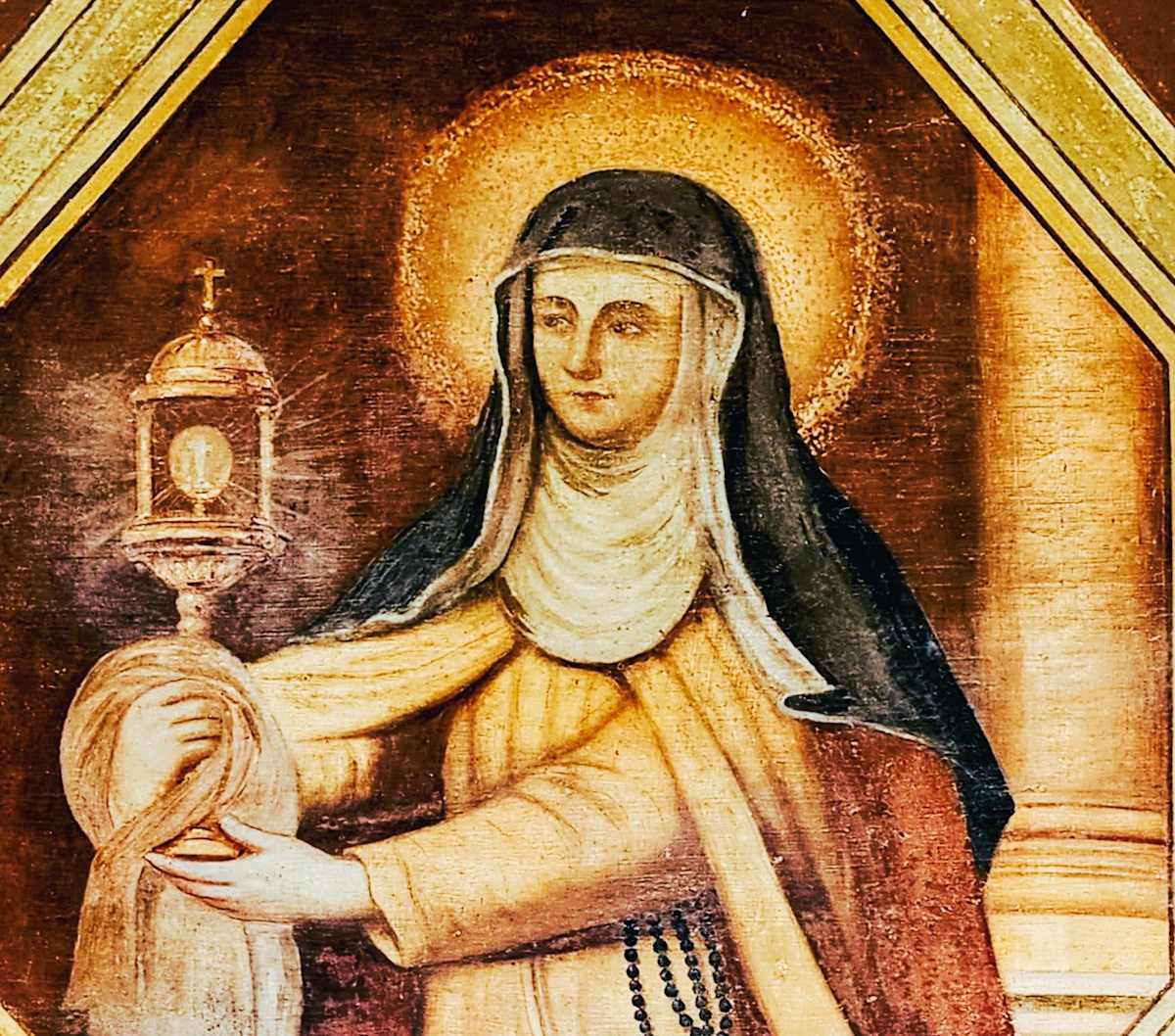
Clare of Assisi is often remembered as the devoted disciple of Francis—the “planticella” who flourished in his shadow. Yet this familiar portrayal risks obscuring a more historically and theologically significant reality: Clare as a figure who not only received the Franciscan charism, but actively shaped its spiritual and ecclesial expression.
Recent developments in historical and Franciscan studies, particularly the recovery and critical translation of medieval sources, have made it possible to reassess her role. Clare now emerges as a subject in her own right; as a woman whose radical commitment to poverty and evangelical life constituted a subtle but real challenge to the social and ecclesial structures of her time. As such, she offers a model of Franciscan life not limited to cloistered women but relevant to Christians across vocations.
A key text in this reassessment is the Processo di Canonizzazione di Santa Chiara (Proc), discovered by fray Zeffirino Lazzeri, OFM, and published in the 1920s. The Processo provides a textured account of Clare’s life through the testimony of those who knew her. It depicts a woman of noble origin who deliberately relinquished her status as a maiore to live among the poor, embodying the evangelical logic of dispossession (sine proprio).
Attention to the language of the Processo is especially revealing. In many Spanish and English translations, the Umbrian Italian term liberazione is rendered as “healing.” While not incorrect, this choice narrows the semantic range of the original. A reading attentive to the umbro-Italian text suggests that Clare’s actions are consistently understood not merely as acts of healing, but as moments of liberation.
For example, sor Pacífica recounts that when several sisters fell ill, Clare made the sign of the cross over them, and “all were liberated” (Proc I,16). This terminology recurs throughout the testimonies: physical illness, psychological distress, demonic affliction, and even communal threats such as war are described in terms of liberation. The pattern suggests that Clare’s contemporaries perceived her not simply as a healer, but as a mediating presence through whom God’s liberating action became effective.
This raises an important theological question: how are we to interpret this liberating dimension of Clare’s spirituality?
Clare did not develop a systematic theology of liberation. Nevertheless, the Processo discloses a coherent forma vitae minorum, a spiritual configuration in which liberation is embodied rather than theorized. Her conversion may be read as a decisive sequela Christi in the form of an embrace of the minores and the poor, while her praxis manifests a constellation of interwoven elements: a contemplative worldview, a preferential option of poverty, a commitment to universal fraternity, a Eucharistic sense of mission, and ongoing formation in the sign of the cross. Taken together, these dimensions constitute a lived, Franciscan spirituality of liberation grounded not in abstract discourse but in an evangelical way of life.
To read Clare in this way is not to impose a modern framework anachronistically, but to allow her witness to enter into dialogue with contemporary theological concerns. As has been shown in the case of Francis by authors such as Leonardo Boff and Pedro de Anasagasti, the saints often disclose dimensions of the Gospel that remain perennially relevant, even as their historical expressions differ.
Clare of Assisi, read through the lens of liberation, does not simply belong to the past. She offers a theologically rich and historically grounded witness to the transformative power of the Gospel; a power that liberates and calls forth agents of liberation in every age.