The other day, I saw Sugar Skulls and Catrinas mixed in with Halloween stuff in a store in Chicago. I was taken aback and disturbed. Let me insist that Día de los Muertos is not Mexican Halloween. It is quite the contrary.
Día de los Muertos begins in the last days of October with the preparation of the altarcitos, our little altars of remembrance. In many communities, each day is dedicated to particular loved ones, with special offerings added daily until November 2. Most begin setting up on October 28, though some begin on October 27. The days unfold like this:
October 27: begin to set up altarcitos by adding pet items in honor of our dead pets.
October 28: begin or continue setting up altarcitos with a candle and white flower in honor of those who died suddenly or in a tragic way.
October 29: add another candle and a glass of water in honor of unremembered souls.
October 30: add more candles and pan de muertos in honor of those who died in an accident or of starvation.
October 31: add fruit, especially oranges and apples, for our ancestors.
On November 1, the Feast of All Saints, we remember the angelitos, the little ones who died much too young. We add some of their favorite toys to the altarcitos, remembering with a sigh and a smile the children they were and the joy they brought into our lives.
On November 2, All Souls' Day, we officially celebrate el Día de los Muertos, honoring our deceased loved ones and all the faithful departed. At the cemetery or at our altarcitos, we pray for the repose of their souls and ask them to pray for and with us. It is a beautiful tradition, filled with sweet, melancholic nostalgia: remembering, welcoming, and maintaining our relationships with our beloved dead.
On November 3, we burn incense, preferably copal, as our final prayer: "Let my prayer be incense before you" (Ps 141:2). And, as popular belief has it, the smoke guides the spirits of our dead loved ones back into the afterlife.
A Christian Vision of Death and Communion
As Christians, we believe that death does not sever the bonds of love. St. Paul, writing to the Corinthians, affirms our victory over death.
“Where, O death, is your victory? Where, O death, is your sting?” (1 Cor 15:55).
“Thanks be to God who gives us the victory through our Lord Jesus Christ” (1 Cor 15:57).
All the baptized are saints on pilgrimage through this life to heaven. Those who have died remain part of the Communion of Saints. Some are already saints in glory; others are being purified on their journey toward God; and we, the Church still on pilgrimage, remain united with them in Christ. El Día de los Muertos becomes, therefore, a domestic liturgy of memory, a sacred remembering of our beloved dead.
In Mexico and throughout much of Latin America, these two Christian feasts have encountered and become inculturated with ancient Mesoamerican rites, symbols, and devotions. The result is a rich, complex tradition that speaks of death not as the negation of life, but as part of the mystery and cycle of human existence. My mother one day told me that death is a part of life and we cannot live well without coming to terms with that reality.
At the heart of this Christian vision is the conviction that the dead are not simply gone. Jesus reminds us that God “is God not of the dead, but of the living” (Mt 22:32). Those who have died continue to live in God, and in Christ they remain mysteriously connected to us. The Communion of Saints reaches beyond the grave, especially to those we love.
“Deep waters cannot quench love, nor rivers sweep it away” (Song 8:7).
Our altarcitos help us cross the rivers that separate us from those who have gone before us.
“Recuérdame”: Memory, Love, and Eucharist
Every year around this time, the movie Coco and its theme song, "Recuérdame," keep coming to mind. I still tear up when Miguel sings to his great-grandmother, Mamá Coco, calling her back to her memories of her father. The film imagines that the dead suffer a second and final death when no one on earth remembers them. It is a tender idea, but our Christian faith tells us something even more hopeful.
Our dead do not live because we remember them; they live because God is God of the living (Mk 12:27; Lk 20:38).
We remember them because we are still in communion with them.
"Recuérdame" is a very Eucharistic word. At the Last Supper, Jesus said, "Hagan esto en memoria mía" (Lk 22:19). Every Mass is a Día de los Muertos of sorts. We remember Christ's death and resurrection as we await his return in glory. In that memory and hope, heaven, purgation, and earth gather around one altar. Our Día de los Muertos celebrations and altarcitos at home are little echoes of that great altar.
Cemeteries and Places of Encounter
During these days, families visit cemeteries and spend time at the graves of relatives and friends. They wash and decorate the tombstones, arrange many-petaled, golden -orange cempasúchil flowers, light candles, pray, and remember. The cemetery becomes not merely a place of death but a place of encounter, memory, prayer, and communion.
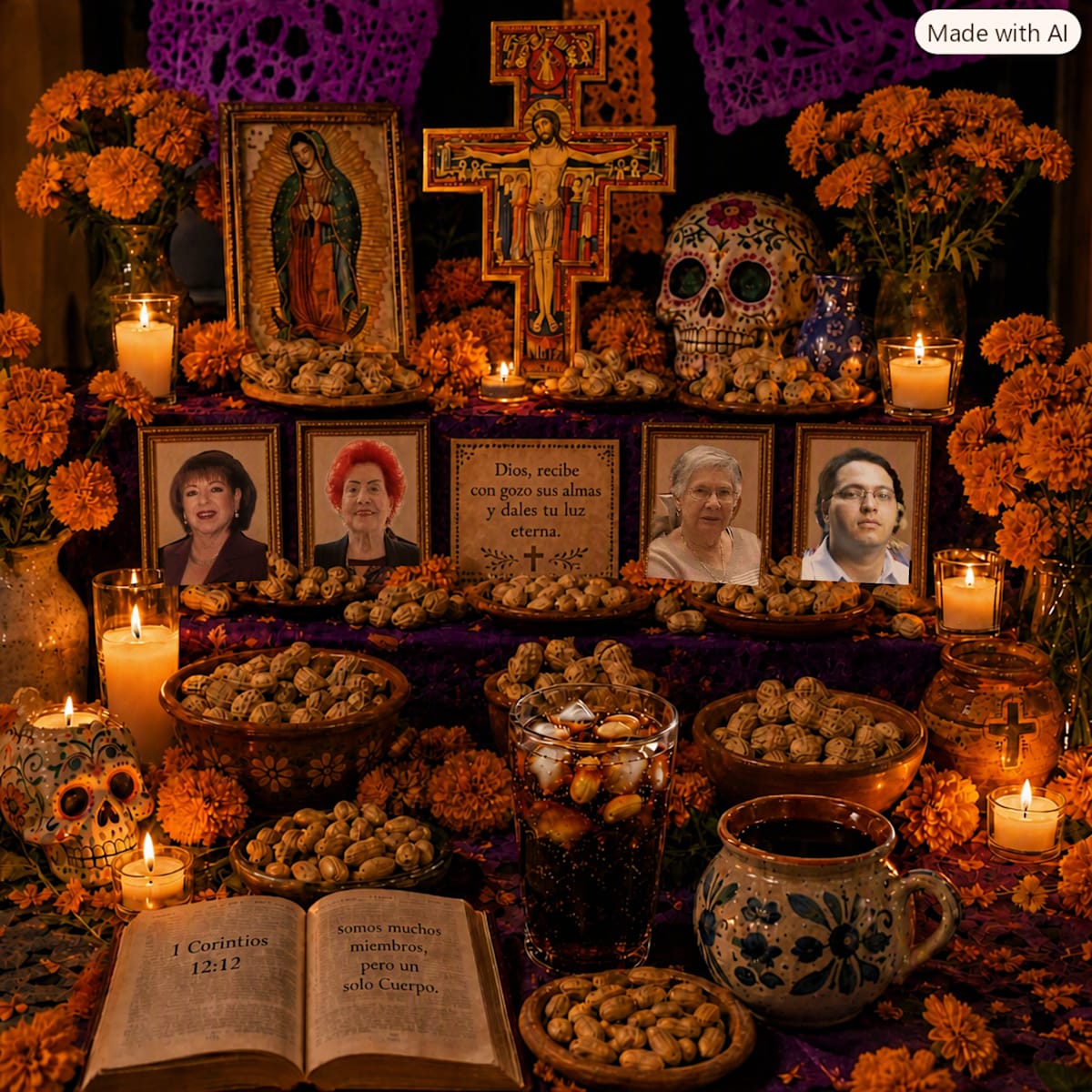
At home, many Latino families construct and decorate altars dedicated to the souls of loved ones who have died. On these altars, we find brightly colored papel picado, Catrinas, Sugar Skulls, photographs of the deceased, religious images, candles, flowers, mole, pan dulce, and other foods. Some families place tequila, rum, brandy, cigarettes, chocolate, or whatever else their loved ones enjoyed during their earthly lives. For deceased children, we add the toys and candies they loved.
I always add peanuts for my mother. She loved peanuts.
My father, my brothers, and I always sprinkle peanuts on her grave when we visit. It is such a small gesture, and yet it says so much. Mamá is still our Mamá. Love remembers even the little things.
This Year’s Altarcito
This year's Día de los Muertos is especially emotional for me. Not since my mother died thirteen years ago has the idea of setting up the altarcitos felt so strangely exciting and yet so dreadful. It is a sort of mysterium tremendum et fascinans (a terrifying yet fascinating mystery).
I have grown accustomed to adding my mother, my godson, mi ahijado Frankie, my novitiate classmate Arturo, my good friend Avis and my dear Rosalinda to the altarcitos, together with so many other relatives and friends who have gone before us. Every year the number of the dead seems to grow as I grow older and come closer to my own death.
This year, however, I carry the sorrow of adding two beloved aunts, Tía Lucinda and Tía Chabelita. Gracias a Dios, both lived long and full lives. Their deaths are nevertheless painful because love makes every loss painful.
I will also be adding the photo of mi prima María del Refugio (Kuquis), with whom I grew up when I lived in Mexico as a little boy. A month before her death, I got to see her on Zoom. She recalled how I would tease her by calling her Refugio, Refugio, Refugio. I reminded her how she would chase after me and give me coscorrones. It was all in fun. Ay, Kuquis, ¿pa' qué te fuiste?
And then there is the photograph that will perhaps be the hardest of all for me to place: that of my dear friend Alex Gaitán, a Claretian missionary who died at the tender age of fifty-one. Fifty-one is much too young.
He died about a month ago, and since then various articles have been written about the wonderful ministry he did on behalf of immigrants, especially those unjustly placed in concentration camps. I read with awe about the remarkable minister he became, but I remember our trips with his mother and tía most. The laughs and insights and the phone calls we shared. I will miss him. I still find myself reaching for the phone to call him and then I remember que ya no está.
But wait, our beloved dead sí están, they are still here with us.
And so we remember them.
We welcome them.
We pray for them and ask them to pray for us.
We entrust them to God's mercy.
May their souls, and the souls of all the faithful departed, rest in peace, held in the close embrace of the Sagrado Corazón de Jesús.
Communion, Not Halloween
Día de los Muertos is definitely not a Mexican Halloween. It is an inculturated All Hallows' Eve vigil, All Saints’ Day, and All Souls’ Day, three days of prayer and remembrance, three days when we celebrate and strengthen our consciousness of the Communion of Saints.
• Those in heaven.
• Those being purified.
• And we who remain here on earth.
We are not three unrelated groups. We are one Church, one Body of Christ, united by the love of God that is stronger than death. We pray for one another. We pray with one another. And we remember those who have gone before us in faith, hope, and love.
That is why the altarcito is more than decoration.
The cemetery visit is more than nostalgia.
The photograph is more than an image.
The candle is more than wax.
The flower is more than a blossom.
Each becomes a sign of communion.
Each says: You are not forgotten. You are still loved. You are still part of us. Te recordamos.
Love Remembers
And ultimately, Día de los Muertos is not about death. It is about Communion. It is about love, which gathers the living and the dead into one great mystery of grace and communion in praise of God the Father, through God the Son, in God the Holy Spirit.
It is about remembering because love remembers.
It is about praying because love prays.
It is about celebrating because love celebrates.
And it is about hoping because, in Christ, death does not have the last word. And, as always in the Cavazos-González altarcitos, theology becomes incarnate in a handful of peanuts.
Paz y bienestar
Fray Gilberto
You can receive Fray Gilberto’s Reflections by signing up for his Author Page Blog.