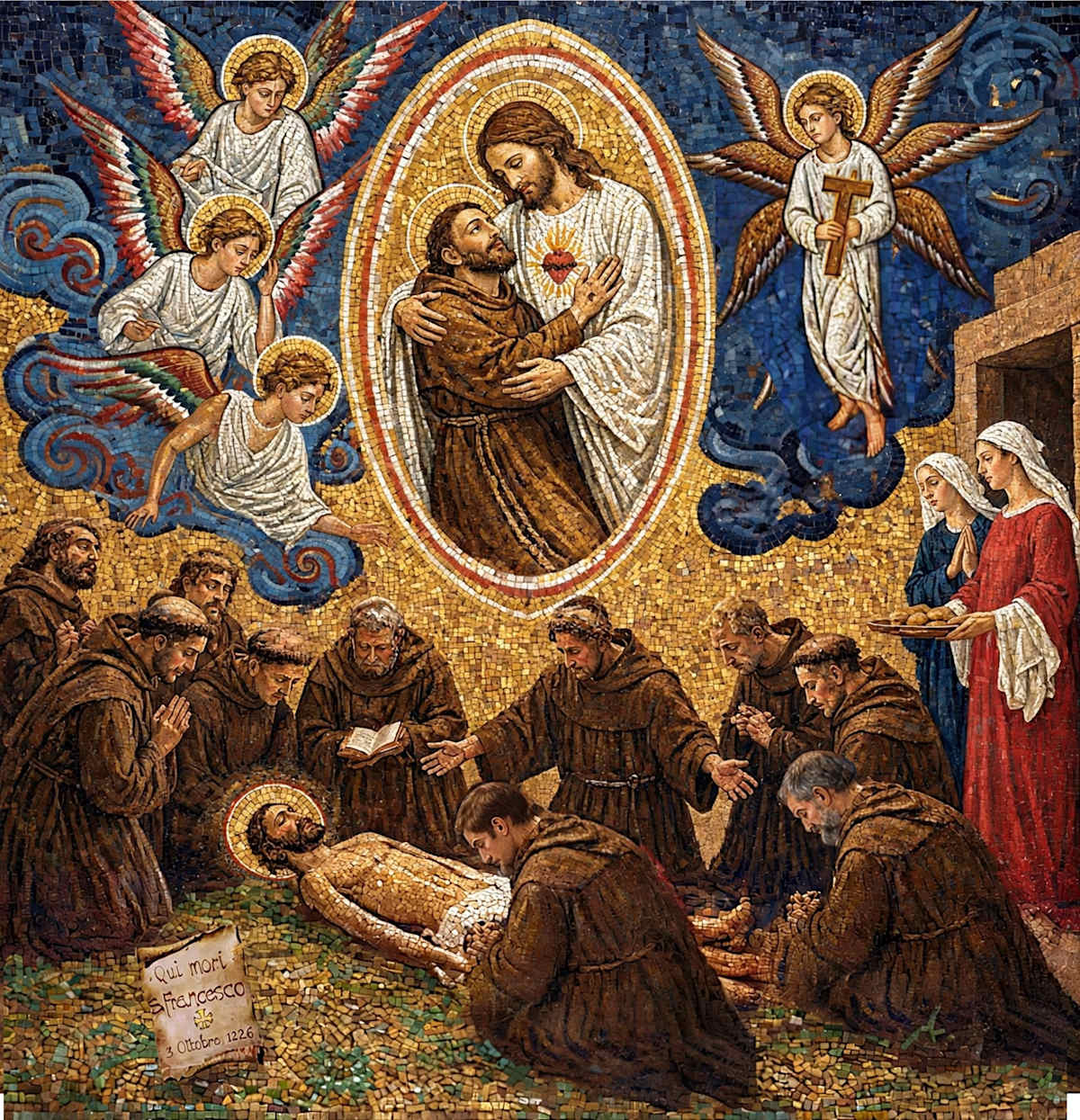
Transitus means crossing over, a passing through. It is the word the earliest Christian community used for Mary’s Dormition, the Transitus Mariae, when her soul was set free into the arms of her Son, three days before her Assumption. When Franciscans looked for a way to narrate the death of our founder, we reached for that same word and shape, fittingly, since Francis had always looked to Santa Maria as a model of our spiritual life. Friars, townspeople, and his friend, Jacoba, gathered around him just as an earlier community had gathered around the Virgin Mother of our Lord. Eight hundred years later, we Franciscans still keep vigil on the night of October 3.
But to understand why Francis's death had to be named a crossing over rather than merely an ending, we must go back to a young man who feared dying on the battlefield but marched into war anyway.
The dream of climbing upward
Francis of Assisi rode out to the battles of Collestrada and Spoleto not because he was brave, but because he hoped to fulfill his father's dream: to climb the social ladder from minores to maiores.
In medieval Assisi, the maiores were the ruling elite, the first-class. The minores, even wealthy ones like Pietro di Bernardone, were second-class. Below them were the miserabiles, the expendable poor, the lesser ones. Francis did not want to be a minore, but second-class was still better than no class.
God had other plans. Defeated in battle, imprisoned, and released only into illness and depression, Francis found himself stripped of the illusions that had driven him. In the caves of the Carceri, in the ruined chapel of San Damiano, in the kiss he gave a leper, he discovered something his father's ambition could never give him: the joy of the Gospel.
His conversion was not a single dramatic moment but a slow conversio, a turning from his earthly father’s dream toward his heavenly Father’s Reign. Liberated from the social conventions that had enslaved him, Francis embraced minoritas, accepting his place as a minore positioned between the maiores and the miserabiles. In that very position he discovered a vocation: to become a bridge between haves and have-nots, a crossing point where the world had preferred distance.
Conversion as contemplative vision and social liberation
This conversion touched everything. Francis developed a contemplative vision that enabled him to see God in the poor and in all creation. He embraced minoritas not as deprivation for its own sake but as a path toward integral liberation, his own and everyone else’s.
As a minore, he built bridges between maiores and miserabiles, refusing to let either remain strangers. His mission was thoroughly Eucharistic: preaching through sacrifice, living in thanksgiving, and forming communion.
He formed himself, as did Clare, under the sign of the Cross, because without the Cross there is no true conversion. What the world sees as failure, we recognize as the kenotic wisdom Paul proclaims in Philippians 2:5–11: Christ, though in the form of God, emptied himself and humbled himself even to death on a cross.
Francis did not give his brotherhood a purely spiritual title, but a socio-economic one. He named his Order the Fratres Minores, the Second-Class Brothers—not as self-abasement, but as a deliberate embrace of the place from which social reconciliation becomes possible. From the beginning, minority was a conversion into that bridging place.
The Transitus as interpretive key
Read through the lens of liberare, liberation, rather than mere passing, Francis's death becomes the final act of a life spent refusing possession: refusing goods, status, his own will, even his own body. He died stripped even of a habit that was not his own. Minoritas, completed, not abandoned.
Picture his final hours at the Porziuncola: laid naked on the bare earth, surrounded by friars, townspeople, and Lady Brother Jacoba, listening to John's account of the Last Supper, blessing bread, sharing Jacoba's almond cookies, weeping over a city he no longer owned and that had never owned him.
His Transitus is the key to his whole life: minority, second-class status completed in joy, joy completed in liberation, liberation completed in communion.
Minority as liberation, not humiliation
The temptation is to hear minoritas as false modesty, and to mistranslate Fratres Minores as "lesser brothers." A liberationist and socio-spiritual lens corrects that. Assisi's class system was built on domination, and Francis and Clare's minoritas was a structural refusal to occupy the place of the maiores. But neither did they invade the place of the truly lesser ones.
Francis kissed and cleansed the lepers; Clare sold her land cheaply to poor families, giving them status and breaking her own family's grip on them. Both encountered Christ in the miserabiles, the no-class, and both were liberated from needing power even as others were freed from domination.
Read this way, minority is not the private virtue of humility but bridge-building between classes, a social act with spiritual, political and economic consequences.
So, we might ask: where have I sought to climb from minor to major rather than take up the bridge-building place Francis and Clare chose? Who are the real lesser ones I am called to stand beside today, not above and not apart from?
Gospel joy as the fruit of liberation
Every Franciscan knows the story of “Perfect Joy” from The Little Flowers. But Francis never actually says “perfect joy” in the original telling; a later English mistranslation replaced true with perfect. In the Latin he speaks of vera laetitia, true joy: verus, meaning real, engaged, rooted like a tree firmly planted, rather than perfectus, meaning finished or complete.
True joy is relational, not manufactured.
Francis tells Brother Leo to write down what true joy is not: not that the masters of Paris have entered the Order, not that bishops and kings have joined, not even that Francis heals the sick by God’s grace. True joy is arriving home on a freezing night, bleeding from ice cutting his legs, and being turned away at his own door by a brother who calls him a simpleton. If he can bear that with patience, there is true joy, true virtue, and the salvation of the soul (FF 278).
Francis is not romanticizing suffering. He is saying that once we no longer need to be recognized, defended, or vindicated, we become free—rooted in vera laetitia, free to love the one who has wronged us. That freedom, not the mistreatment, is the joy.
Living sine proprio, with nothing of our own, leaves us with nothing left to protect. We become free to love without calculation—the joy available to the minores in relationship with the miserabiles and even the maiores, as brothers and sisters who need one another.
Prayer sustains it
Prayer, for the first Franciscans, was never a retreat from the world's lucha. It was where minority and joy were renewed by meeting God in the cotidiano, the everyday.
Without prayer, minority collapses into a martyrdom complex, and service into burnout or control. Even ministries born of real love for the truly lesser ones can curdle, over years, into a quiet need to be needed, and we climb right back onto the ladder Francis walked away from. Prayer interrupts that drift, keeping us awake to a God already present in the traffic, the clinic waiting room, the parish meeting that runs too long, the everyday routine of life.
Our own passing over
We have walked with Francis from the battlefields of Assisi to the caves of the Carceri, from his father's dream of prestige to the joyful service of the Father's Reign, from minores seeking to become maiores to minoritas embraced as the bridge between the haves and have-nots.
As bridges, we should expect to be walked on.
May we be strong and beautiful bridges for all God's people and creation, having found true joy in relationship rather than achievement.
Having arrived at the moment of his final Transitus, Francis naked upon the bare earth bids farewell to his brothers saying “I have done what is mine; may Christ teach you yours.” ¿Y qué? What does Francis’ Transitus ask of us today? What is ours to do? What transitions are we called to make to act as bridges of recollection and service?
Paz y bienestar.
Fray Gilberto Cavazos-González, OFM
You can receive Fray Gilberto’s Reflections by signing up for his Author Page and Blog.