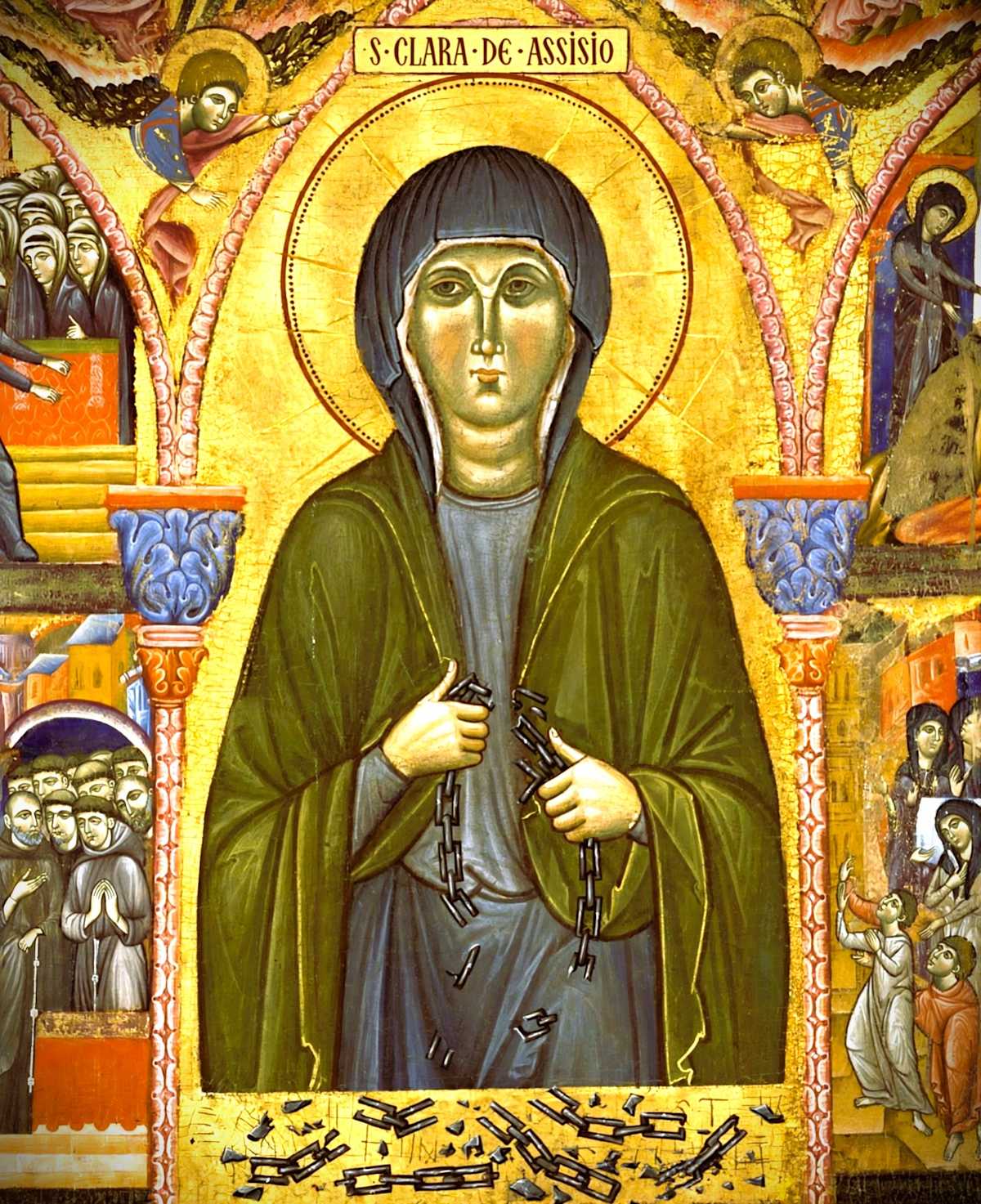
I love the month of August. It begins with the Feast of the Pardon in honor of Santa Maria degli Angeli, patroness of the Franciscan famiglia, and moves through various saints like San Lorenzo, Santo Domingo, Santa Rosa de Lima, San Agustín and his mother Mónica. It also celebrates the birth of significant people in my life like Brat Joachim, Brat Juraj, Frate Graziano, Friar Jimmy. mi sobrinita Emma, mis padres Gilberto y Emma, mi cuñada Norma, mis primas Juanita y Linda, and ends with el cumpleaños de mi amigo Fray Javier. Yes, there is a lot to celebrate in August: the Lord is Transfigured and the Mother of our Lord is Assumed into heaven. With all of this, I still have one more reason to love el mes de Agosto.
I was born on the 11th of August, la fiesta de Santa Clara, in the same year that the Poor Clares allowed the San Damiano Crucifix and the oldest tavola icon of Clare to be put on public display after having been hidden in their private chapel for seven centuries. I did not choose that coincidence, but I have spent most of my scholarly life living into it. When the Franciscan Province of the Sacred Heart of Jesus sent me to study at the Antonianum in Rome, it happened to be the year of Clare's 800th birthday. I decided, with the confidence only a young friar has, that my study of Clare was meant to be. She is mi hermana and my patroness and I wanted to get to know her as well as possible.
Much had already been written on Clare and her own writings. But it was the Clare scholar Marco Bartoli who gave me what every graduate student craves: the seeds of a thesis topic. Little, he told me, had been done on the Processo di Canonizzazione di s. Chiara d'Assisi, the process of canonization compiled three months after her death in November of 1253. I read it and reread it in español, italiano, English, even au français. Nothing struck me.
Then my thesis director, Fray Fernando Uribe, a student of the great Franciscanologist Kajetan Esser, told me what every good graduate student eventually has to read and deal with: the original text. Traduttori traditori, as the saying goes. Translators are traitors. Translations never quite carry the wealth of the original.
Being told to read the Processo in its original fifteenth-century Umbrian was about as welcome as a kick in the pants. There was nowhere to learn Medieval Umbrian. I had no choice but to read it, and reread it, several times. It was on my seventh pass that my Latinidad kicked in. The scales fell from my eyes, and I found myself face to face with Medieval Espanglish. Like Espanglish, Medieval Umbrian is a mestizaje de lenguas, a mixture of Latin, Spanish, and Italian. Mi familia knows I've been mixing languages since childhood; reading Umbrian suddenly came easily. And that is when Clare's Processo opened itself to me. I found in it not simply a healer, but an impressive woman of liberation, one who, having been liberated by God, gave herself in turn to the liberation of others.
What the Words Themselves Were Saying
When I set the Umbrian text beside the modern Spanish and English translations, the difference in vocabulary was hard to miss. The word liberatione, liberation, appears thirteen times in the Processo. The verb liberare, to liberate, appears in seventy-four different conjugated forms. Clare herself is described as liberale, liberal, meaning generous. This is not incidental vocabulary. It is a language of liberation running through the whole document.
And yet, again and again, the modern translations quietly convert this language into the language of healing. Ignacio Omaechevarría's Spanish edition translates liberare as some form of "to free" only fifteen of those seventy-four times; the other fifty-nine times he renders it as "to heal," or simply as "healing." Regis Armstrong's English edition, Clare of Assisi: Early Documents, does much the same: of the seventy-four occurrences, he uses "liberated" once, "delivered" once, "to free" six times, and reaches for "to cure" or "to heal" the rest of the time, on one occasion not translating the word at all.
The witnesses at Clare's canonization did not experience this ambiguity. When Sister Benvenuta testified about Friar Stephen, who had lost his mind and was sent by Francis to San Damiano so that Clare might make the sign of the cross over him, she said simply that he woke and partisse liberato, he left liberated. When another sister recovered from illness after Clare blessed her, the text says she was sanata et liberata, cured and liberated, both words, side by side, doing different work. The sisters spoke the same way about San Damiano and the city of Assisi being freed from the Saracens as they did about bodies and minds being freed from affliction. For them, it was one continuous vocabulary. Clare liberated the sick, liberated the troubled, liberated the monastery, liberated the city. The translators, working within a habit of thought that separates the spiritual from the social, split what the witnesses had not split.
From a Philological Discovery to a Spirituality
With that discovery, Fray Fernando sent me to Latin American liberation theology to ask what a Christian spirituality of liberation might look like when read back into Clare's own century. I defended my license thesis in 1996. In my earliest published treatment of this material, in The Cord in 2002, I named five currents running through the Processo's witness to Clare: contemplation, poverty, fraternity and sorority, the Eucharist, and the sign of the Cross. Each of these, I argued, carries the Christian forward toward the Reign of God by way of identification with the humiliated, poor, naked, and crucified Christ found in the poor, the least, the marginalized, and oppressed of this world.
A decade later, on the occasion of my promotion to full professor at Catholic Theological Union, I returned to Clare and found the five currents had grown into seven components: embracing the reality of our cotidiano, an ongoing conversion to Christ and to God's Reign, a contemplative worldview, a preferential option for poverty, the solidarity of a universal sorority and fraternity, the Eucharistic communion of the Church, and the sign of the Cross as an instrument of liberation. The additions, the reality of our cotidiano and conversion to God’s Reign, were not afterthoughts. They named what had been implicit all along: that Clare's liberation begins in fidelity to the reality of the concrete, daily conditions of a noble family's wealth, a city's war, and a young woman's exile, and that it moves through a real conversion, the decisive turning on that Palm Sunday night when she abandoned her family's house, before it ever becomes contemplation, poverty, or Eucharist. Liberation, in other words, is not one item on a list. It is the movement that carries a person through all the others.
Reading Clare Today
Return to that thirteenth-century vocabulary now, with the additional distance of contemporary Franciscan scholarship, and something further comes into focus. Clare is too easily remembered as the planticella, the little plant who flourished in Francis's shadow. The Processo, read on its own terms, resists that image. It presents a woman of noble origin who deliberately relinquished her status as a maiore to live as a minore in service of the poor, embodying the evangelical logic of dispossession, sine proprio, having nothing of one's own. She is not simply the recipient of a charism Francis handed to her. She is a subject in her own right, whose radical commitment to Jesus Christ in poverty and evangelical life posed a real, if quiet, challenge to the social and ecclesial structures of her age.
Clare never wrote a systematic theology of liberation, and it would be a mistake to hand her one now. What the Processo discloses instead is a coherent forma vitae minorum, a form of life in which liberation is embodied rather than theorized. Her conversion can be read as a decisive sequela Christi, a following of Christ in the form of embracing the minores and the poor, while her praxis holds together the same constellation her witnesses named: a contemplative worldview, a preferential option for poverty, a commitment to the universal fellowship of brothers and sisters, a Eucharistic sense of mission, and an ongoing formation in the sign of the Cross. As with Francis, in the readings offered by Leonardo Boff and Pedro de Anasagasti, the saints keep disclosing dimensions of the Gospel that stay perennially relevant even as their historical expressions change.
That is not an anachronism imposed on the thirteenth century. It is what happens when a text is finally read in its own words, in its own tongue, by someone faithful to the reality of his own cotidiano, and whose own tongue happens to also be a mestizaje. Clare of Assisi, read this way, does not belong only to the past. She remains a theologically rich and historically grounded witness to a Gospel power that liberates, and that calls forth liberators, in every age.
Paz y bienestar.
This reflection draws together three moments in an ongoing project: "The Spirituality of Liberation in Clare's Process of Canonization" (The Cord, 2002), "A Return to Clare and Liberation" (CTU, 2012), and current work toward a possible new book: Santa Clara and Liberation Spirituality.